



Beschreibung

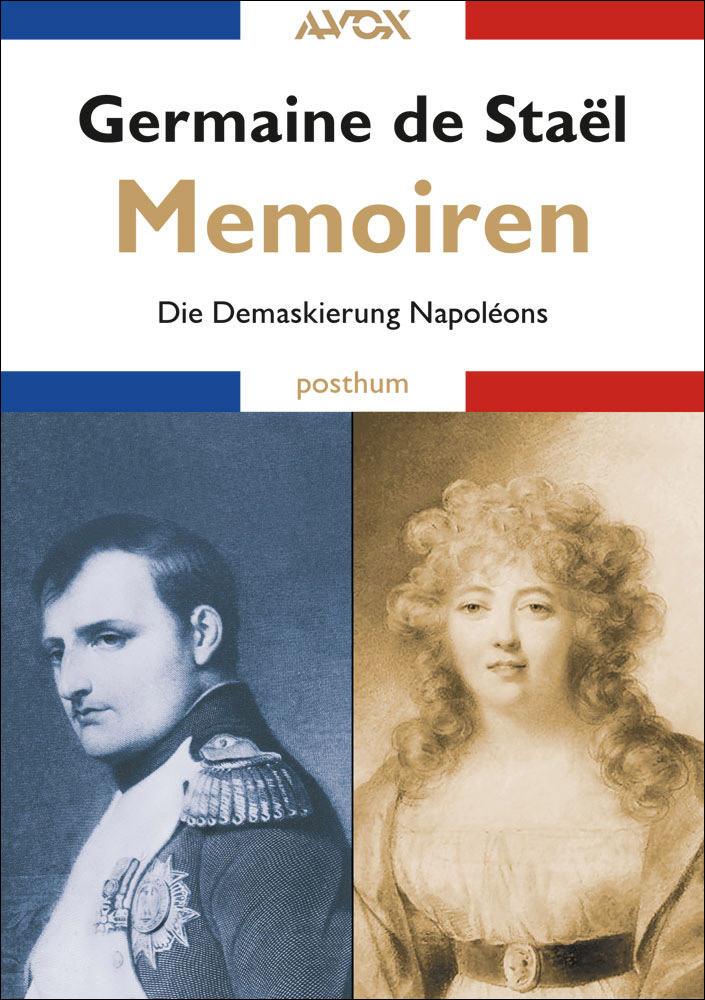
Memoiren. The Unmasking of Napoléon
by Germaine de Staël
with 26 contemporary illustrations and a detailed introduction to the memoirs and life of Germaine de Staël by Ulrich Taschow
382 pages, paperback, 3rd edition 2013, series: avox ad fontes, ISBN: 978-3-936979-03-9
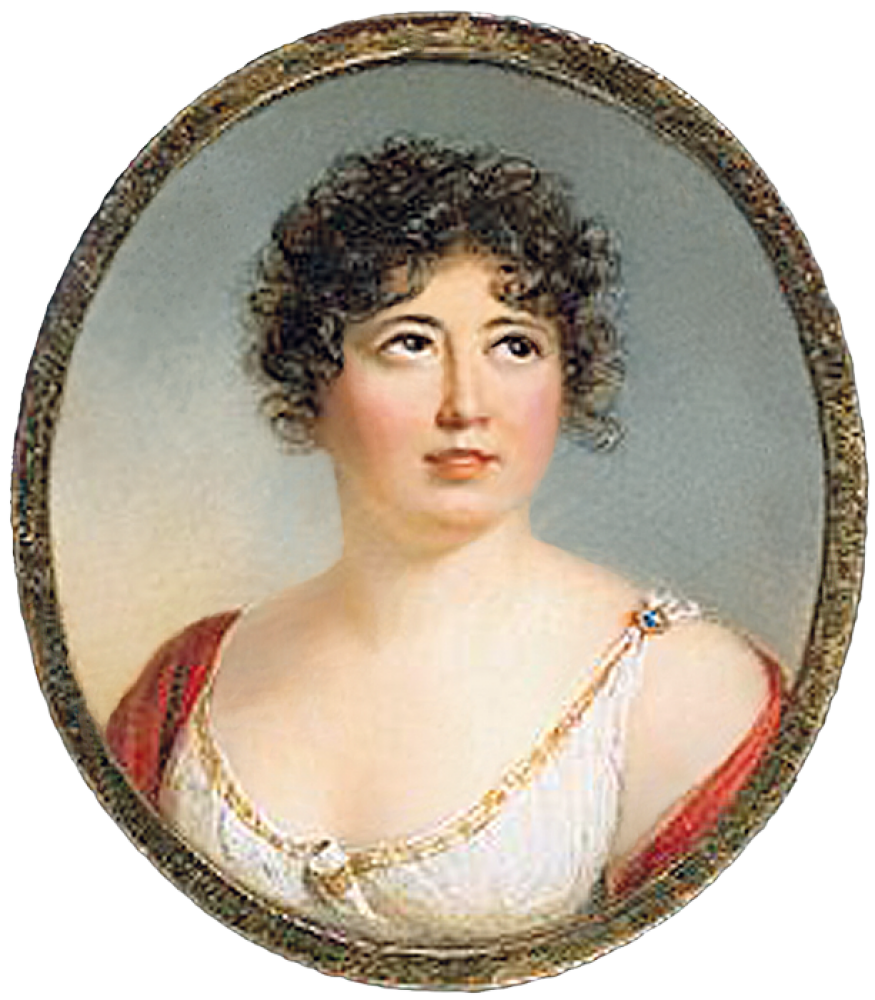
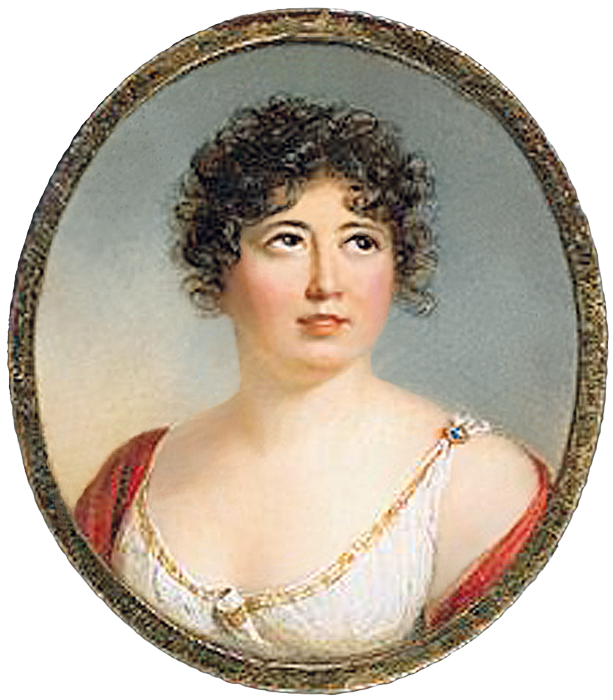 Germaine de Staël
at the age of 34
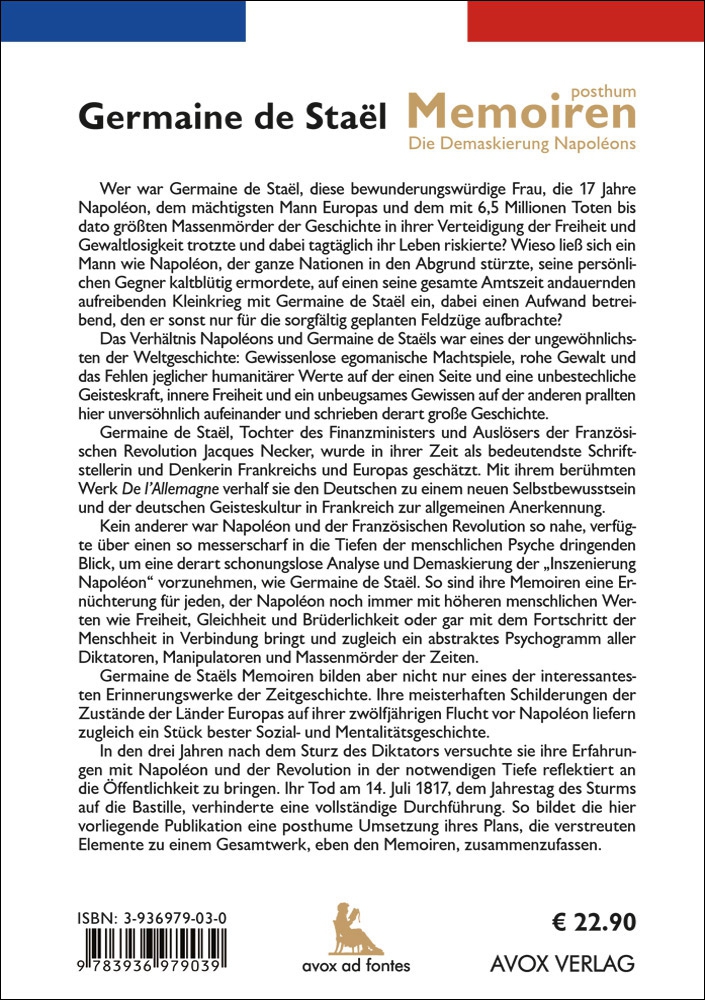
Who was Germaine de Staël, this admirable woman who for seventeen years defied Napoléon, the most powerful man in Europe and, with 6.5 million dead, the greatest mass murderer in history up to that time, defending freedom and nonviolence while risking her life every single day?
Why did a man like Napoléon, who plunged entire nations into the abyss and had his personal opponents cold-bloodedly murdered, enter into a nerve-racking private war with Germaine de Staël that lasted throughout his entire term of office, expending an effort otherwise reserved only for his carefully planned campaigns? The relationship between Napoléon and Germaine de Staël was one of the most unusual in world history: ruthless egomaniacal power games, brute violence, and the complete absence of any humanitarian values on one side, and an incorruptible power of mind, inner freedom, and an unbending conscience on the other collided here irreconcilably and wrote history on the grandest scale.
Germaine de Staël, daughter of the finance minister and catalyst of the French Revolution Jacques Necker, was esteemed in her time as the most important writer and thinker of France and Europe. With her famous work De l’Allemagne, she helped the Germans gain a new self-confidence and brought German intellectual culture to general recognition in France.
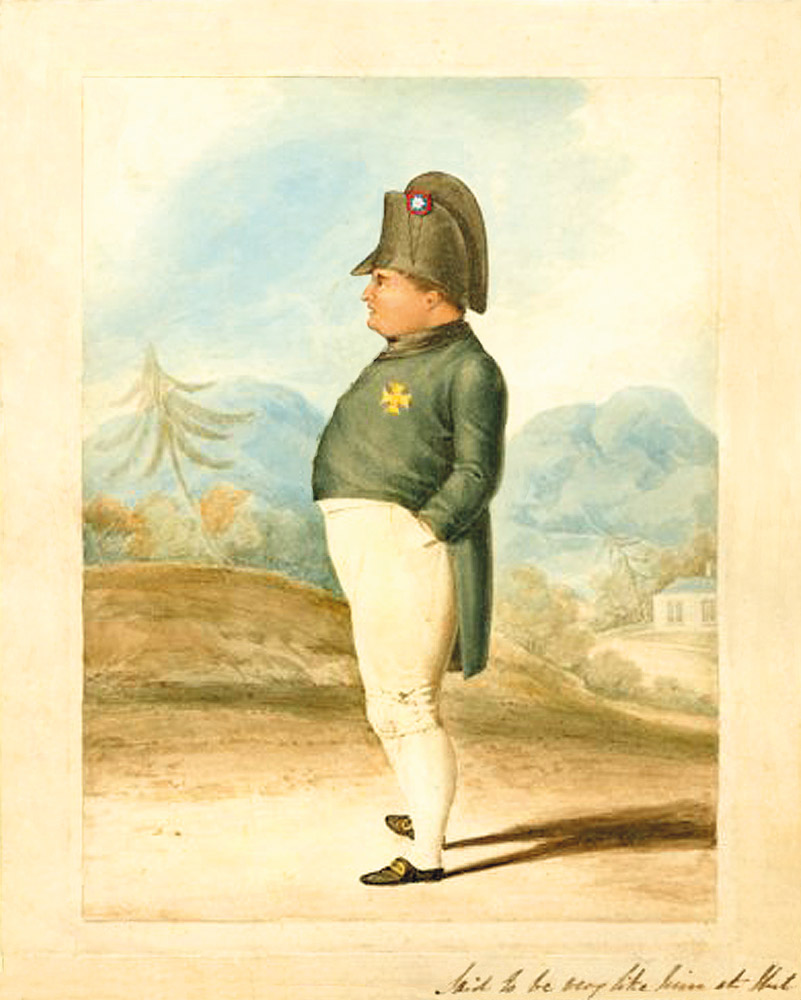 Napoléon in exile
on Saint Helena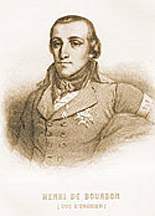 Louis Antoine Henri de
Bourbon-Condé,
Duc d’Enghien (1772-1804),
murdered by Napoléon
on March 21, 1804
No one else was as close to Napoléon and the French Revolution, or possessed such a razor-sharp gaze into the depths of the human psyche, as Germaine de Staël when she undertook this unsparing analysis and unmasking of the “staging of Napoléon.” Her memoirs are therefore sobering reading for anyone who still associates Napoléon with higher human values such as liberty, equality, fraternity, or even with the progress of humanity, and at the same time they form an abstract psychogram of dictators, manipulators, and mass murderers throughout the ages.
Yet Germaine de Staël’s memoirs are not only one of the most interesting and gripping memoir works of contemporary history; her masterly descriptions of the conditions in the countries of Europe during her twelve-year flight from Napoléon also provide a first-rate piece of social and mental history.
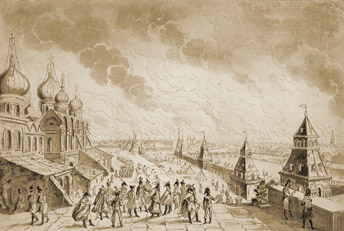 Napoléon in September 1812 at the Kremlin,
with burning Moscow before him
In the three years following the fall of the dictator, Germaine de Staël tried to bring her experiences with Napoléon and the Revolution before the public with the necessary depth of reflection. Her death on July 14, 1817, the anniversary of the storming of the Bastille, prevented her from completing this plan. The present publication is therefore a posthumous realization of her intention to gather the scattered elements into a single work: the memoirs.
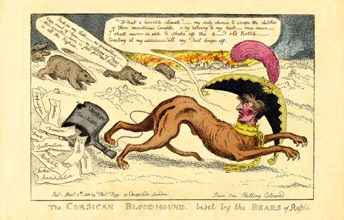 Contemporary English caricature of the “bloodhound
Napoléon” and the defeat of his army in Russia
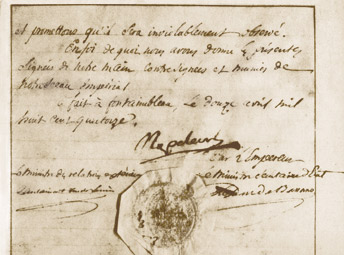 Napoléon’s unconditional abdication on April 14, 1814
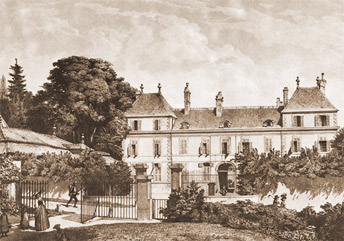 Germaine de Staël’s exile: Coppet Castle, Switzerland