
Nicole Oresme und der Frühling der Moderne
The origins of our modern quantitative-metric strategies of world appropriation
and modern culture of consciousness and science by Ulrich Taschow
Articles on Oresme
 Die Welt auf dem Reissbrett: Klingende Physik, Metrologie des Geistes und die Erfindung der exakten Naturwissenschaften in: Was zählt. Ordnungsangebote, Gebrauchsformen und Erfahrungsmodalitäten des »numerus« im Mittelalter, April 2012, S. 295-331, Böhlau, Köln, ISBN-13: 978-3412207892 AbstractDer Artikel liefert einen Überblick über die bis dato weitestgehend unbekannten Ursprünge der neuzeitlichen Mathematisierungs- und Quantifizierungsintentionen und -methoden im 13./14. Jahrhundert, die entgegen positivistischer Wissenschaftstheorien weder aus einer praktischen Notwendigkeit heraus erwuchsen, noch im Verständnis des heutigen naturwissenschaftlichen Paradigmas einer Überprüfung in der Praxis standhalten mussten. Dennoch und gerade deshalb bilden diese erstaunlichen mittelalterlichen Innovationen die bis heute niemals reflektierte weltanschauliche, wissenschaftsreligiöse und wissensdogmatische Grundlage der westlichen Naturwissenschaften bis in die Gegenwart. | |
| Zum Artikel | |
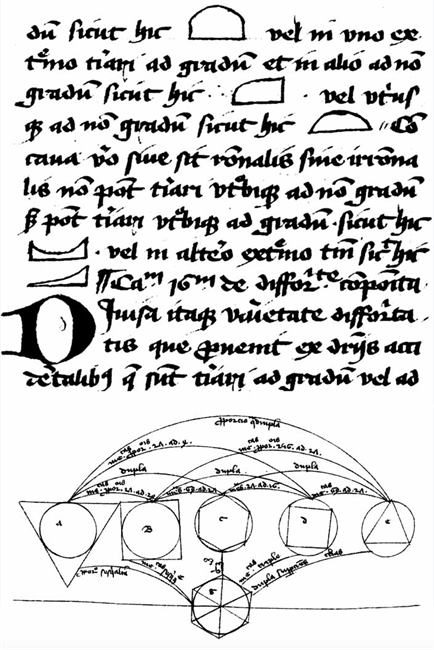
 Die Bedeutung der Musik als Modell für Nicole Oresmes Theorie „De configurationibus qualitatum et motuum“, in: Early Science and Medicine, Vol. IV, No. 1 February 1999, S. 37-90, Brill, Netherlands AbstractThis essay is dedicated to the search for the origins of our modern quantitative and metric approach to nature which, according to evidence here presented, are to be found in the medieval science of acoustics. The central figure in our argument is Nicole Oresme, whose Tractatus de configurationibus qualitatum et motuum of ca. 1350 featured novel graphic techniques which figuratively represented intensities of permanent qualities and intensities of qualities and velocities over time in terms of multidimensional functions. Closely related to this method was the development of a qualitative measure of qualities (quantitas qualitatis). This new and purely mathematical view of the problem rendered the century-old debate over the ontological status of qualities (intensio et remissio formarum) quite redundant. It is usually claimed that Oresme's method lacked both an empirical base and a measurable application, that it possessed a merely hypothetical or metaphysical nature and that it was given to figurative symbolism. However, this view is badly mistaken, for it ignores the results presented in Oresme's large section on music. For upon closer scrutiny, Oresme's views on music reveal themselves as the core to his concerns and as our key to the complete re-evaluation of his methodology. His musical doctrines are also of great interest as precursors to the seventeenth century's concerns with the scientific bases of acoustic and Helmholtz' nineteenth-century investigations of sound psychology. | |
| Zum Artikel |
 Theorie der Wissenschaft und Theorie der Musik in Nicole Oresmes „De configurationibus qualitatum et motuum“ in: Systematische Musikwissenschaft, Towards the 21st Century, 1997, V/2, S. 289-334 AbstractEnglish In this essay it is intended to undertake an investigation into the origins of our modern strategies of quantification and measurement of nature, with a particular focus on the beginnings of a scientific acoustics. Based on an analysis of the Tractatus de configurationibus qualitatum et motuum of Nicole Oresme (14th century) the text presents new acoustical and musical results in the fields of history of science and musicology. Furthermore the article reveals that - contrary to today‘s self-image of music and science - music was an important model for the development of analytical geometry as well as for the evolution of empirical-metrical intentions, convictions and methods and, thus, for the genesis of the modern natural sciences in general. The history of scientific acoustics must be regarded as having started with Oresme in the 14th century already, who in his approach anticipated Helmholtz‘s overtone-theory etc. Deutsch Dieser Essay unternimmt eine Spurensuche nach den Ursprüngen unserer neuzeitlichen quantitativ-metrischen Weltaneignungsstrategien, insbesondere den Anfängen einer wissenschaftlichen Akustik. An Hand des Tractatus de configurationibus qualitatum et motuum des Nicole Oresme (14. Jh.) werden nicht nur bis dato der Musikwissenschaft wie auch Wissenschaftsgeschichte unbekannte akustik- und musikgeschichtliche Ergebnisse vorgestellt, sondern zugleich aufgezeigt, daß (entgegen heutigem Selbstverständnis von Musik und Wissenschaft) gerade der Musik eine wesentliche Modellbedeutung für die Anfänge einer analytischen Geometrie, für die Ausbildung empirisch-metrischer Ideale und Verfahren etc. und somit für die Genese der neuzeitlichen Naturwissenschaften zukam. Mit Oresme, der auf seine Weise z.B. die Helmholtzsche Partialtontheorie vorwegnimmt, beginnt bereits im 14. Jh. die Geschichte einer wissenschaftlichen Akustik. Français Cette étude se propose pour but de mettre en lumière les origines des différentes stratégies mises en oeuvre, surtout depuis l‘établissement en science de l‘acoustique, afin de quantifier et de mesurer la nature. En nous fondant sur le Tractatus de configurationibus qualitatum et motuum, de Nicolas Oresme (XIVe siècle), nous ferons apparaître un certain nombre de phénomènes négligés jusqu‘ici tant par les spécialistes de l‘acoustique que par les historiens de la science et de la musique. De plus, nous montrerons que, contrairement aux interprétations faites de nos jours de la musique et science, celle-ci a assumé longtemps une fonction de modèle pour la géométrie analytique, la formation de critères et de schémas métriques, et qu‘elle a, par conséquent, influencé de façon majeure le renouveau des sciences à l‘époque moderne. Oresme, en un sens le précurseur de la ”Partialtontheorie” de Helmholtz, marque le début, au XIVe siècle, de l‘histoire d‘une acoustique perçue comme science. |